 GridBT
What is Grid Trading?
Grid trading does not try to predict market direction. It profits from volatility. Place buy and sell orders at regular price intervals, let the price oscillate through them, and collect a small profit on every cycle.
How it works
A grid bot places a ladder of buy orders below the current price and sell orders above it.
When price dips and hits a buy order, the bot fills it and immediately places a sell one level up. When that sell fills, a new buy goes back below. That cycle repeats forever. Every completed buy-sell pair captures a fixed profit equal to the grid spacing.
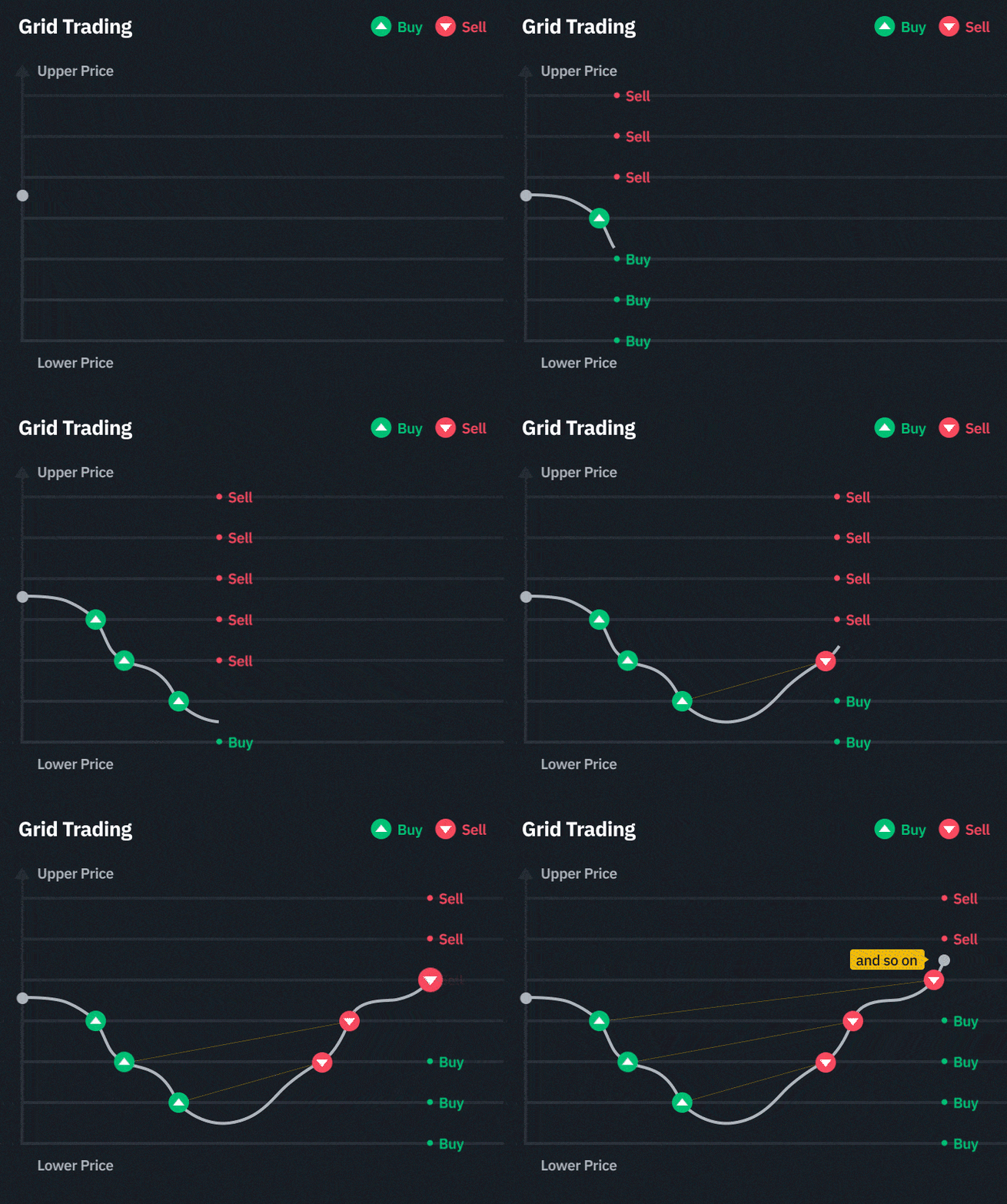
Price oscillates through the grid. Each crossing completes a buy-sell cycle and adds profit.
The more price oscillates, the more cycles complete, the more profit accumulates. The bot never tries to call a top or a bottom. It just works the range.
Worked example
HYPE/USDT at $30.00, 0.5% spacing, $10 per order, 40 total orders
| Setting | Value |
|---|---|
| Current price | $30.00 |
| Grid spacing | 0.5% = $0.15 per level |
| Order size | $10 per order |
| Buy orders | 20 orders: $29.85 down to $27.15 |
| Sell orders | 20 orders: $30.15 up to $32.85 |
| Total coverage | ~$27 to ~$33 (20% range) |
| Capital deployed | 40 × $10 = $400 |
One completed cycle:
| Step | Price | What happens |
|---|---|---|
| Grid active | $30.00 | Buy waiting at $29.85, sell waiting at $30.15 |
| Price dips | $29.85 | Buy fills. Bot holds HYPE worth $10. |
| Price recovers | $30.00 | Sell fills. Bot receives $10.05. |
| Level refilled | $30.00 | Buy order immediately re-placed at $29.85. |
| Profit captured | +$0.05 per cycle (0.5% of $10 order) |
Every completed cycle, the vacated slot is instantly refilled with the opposite order. A filled buy becomes an active sell at the next level up. A filled sell becomes an active buy at the next level down. All 40 levels stay occupied at all times.
What happens in different markets?
| Market condition | What the bot does |
|---|---|
| Ranging (price bounces) | Full cycles complete constantly. This is peak performance. |
| Slow trend up | Grid extends upward as price rises. Long side sells inventory for profit, short side accumulates. |
| Slow trend down | Grid extends downward. Short side profits, long side accumulates. |
| Sharp spike or crash | Built-in protection pauses new accumulation during the sharp move, then rebuilds the grid once price stabilises. |
| Prolonged crash | Long side accumulates toward its limit. Short side keeps capturing grid profits on the way down, partially offsetting unrealized losses. Once the hard cap is reached, the bot holds and waits. |
How GridBT is different
Most exchange grid bots (Binance, Bybit) stop trading when price exits a fixed price range. GridBT does not have that limitation:
- No price boundaries. The grid extends automatically as price moves. There is no upper or lower limit where the bot stops.
- Long and short run simultaneously. Both sides are always active on every pair. The long profits as price rises. The short profits as it falls. They share one margin pool.
- Adaptive order sizing. Order sizes adjust based on market conditions, position imbalance, and profit levels. Exchange bots use fixed sizes regardless of context.
GridBT requires a Bybit Unified Trading Account (UTA) with Hedge Mode enabled. This is what allows both sides to run independently on the same symbol without one closing the other.
Risk to know before you start
The bot bets on the asset recovering
GridBT is long-biased. The short side runs at half the order size of the long side by default. This is intentional: a market can only fall to zero, but it can pump without a ceiling. The short provides a partial hedge, not a neutral position.
That means GridBT is not a safe harbour in a bear market for assets that go to zero. It is designed for assets with long-term recovery potential where the strategy can survive a drawdown and compound back.
Liquidation is real
Because GridBT uses leverage on a cross-margin account, your entire sub-account balance backs all open positions. If total losses grow large enough to exhaust that balance, Bybit liquidates.
The approximate price move required before liquidation becomes a serious risk:
| Leverage (Bybit setting) | Approximate liquidation distance |
|---|---|
| 3x | ~30-33% sustained adverse move |
| 5x | ~18-20% sustained adverse move |
| 10x | ~9-10% sustained adverse move |
Three things directly control your liquidation buffer:
- Hard cap. How large positions are allowed to grow. Set in your config.
- Leverage. Set per pair in Bybit. Lower leverage means a wider buffer.
- Wallet size. More funds in the sub-account means more cushion.
The Conservative starting configuration keeps liquidation a remote scenario under normal market conditions. See Position Sizing for the exact numbers.